

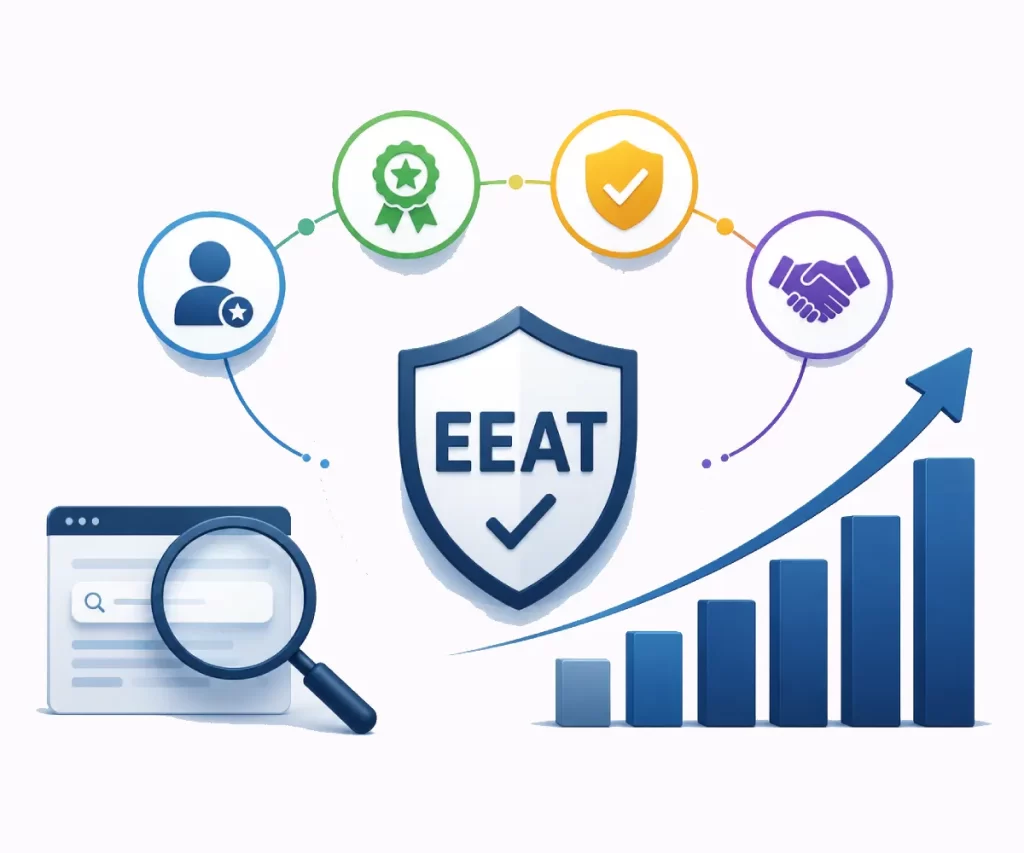
In today’s digital marketing universe, where artificial intelligence generates content faster than you can say “optimization,” and Google changes its algorithm more often than we change our profile picture, one concept remains king, father, emperor: EEAT. If the name sounds like something you’d order at a restaurant, it’s time for a serious update. Sit back, because we’re going to dissect why EEAT isn’t just another acronym to throw around in meetings, but the compass that guides any modern SEO strategy to success. And, more importantly, how to use it to propel your business to the first page in Romania, not just in your entrepreneurial dreams.
For many, SEO seems like black magic. A series of technical incantations, backlinks, and keywords. But the truth is, Google has become increasingly human. It wants to offer its users not only answers, but correct, useful, and trustworthy answers. This is where EEAT comes in, a set of principles that separates the wheat from the chaff, quality content from “filler” created on an assembly line. It’s time to move beyond technicalities and talk about real value, about how to build a brand that both Google and your customers will love and respect.
What is EEAT and why is it vital for modern SEO?
Okay, let’s lay our cards on the table. EEAT is an acronym for Experience, Expertise, Authoritativeness, Trustworthiness. It’s an upgrade from the old EAT concept, to which Google has, unsurprisingly, added the “Experience” component. Let’s take them one by one:
- Experience: Do you demonstrate that you’ve used the product, visited the place, or been through the situation you’re writing about? Google wants to see content created by people who know what they’re talking about from practice, not just theory. A review of a hiking boot written by someone who has climbed Mount Moldoveanu carries more weight than one written from behind a desk.
- Expertise: Do you have the technical knowledge and qualifications required in your field? If you’re writing about medical advice, are you a doctor? If you’re offering financial advice, do you have certifications? Here we’re talking about the formal background and in-depth knowledge that validates you as an expert.
- Authoritativeness: Are you recognized as a leading voice in your niche? Do other experts cite you? Do relevant sites link to you? Authority is built over time, through mentions, quality backlinks, and constant presence in industry conversations. It’s like real-life reputation, but translated online.
- Trustworthiness: How trustworthy is your site? Is the information accurate and verified? Do you have a clear contact page, terms and conditions, positive reviews? Site security (HTTPS) and transparency are crucial. Users need to feel safe when interacting with your brand.
Why is EEAT vital?
Because Google’s algorithm, supported by thousands of human evaluators, uses these signals to determine the quality of a page. A high EEAT score indirectly translates into better rankings, increased traffic, and ultimately, more conversions. Ignoring these principles is like trying to navigate the ocean without a compass: you might get somewhere, but probably not where you intended.
The difference between EEAT and related SEO concepts (YMYL)
Often, in discussions about EEAT, another acronym appears: YMYL, which stands for “Your Money or Your Life.” No, it’s not a threat, but Google’s classification for topics that can have a significant impact on a person’s health, happiness, financial safety, or well-being. Think of medical, financial, legal, news sites, or even complex online stores. For these YMYL pages, EEAT standards are applied with maximum strictness. Incorrect information about medication dosage or an investment can have disastrous consequences, and Google treats this risk with the utmost seriousness.
So, how are they connected? Simple: YMYL is the type of content, and EEAT is the quality standard by which that content is evaluated. Basically, if your site is considered YMYL, you need to excel in EEAT to have any chance in the SERPs. Therefore, they are not mutually exclusive but complement each other, forming the core of Google’s philosophy regarding user safety. As for the question “is it E-E-A-T or eat?”, in agency jargon, you’ll hear both. “Eat” is the quick version, but “E-E-A-T” is the correct one, emphasizing the new Experience component.
The strategic role of Danco Vision in implementing EEAT
Now that we’ve clarified the theory, let’s move on to practice. How do you transform these abstract concepts into concrete results for a business in Romania? This is where we come in. At Danco Vision, we don’t view EEAT as a simple checklist to tick off; we integrate it into the DNA of every digital marketing strategy we’ve developed since 2006. For us, EEAT isn’t a trend, it’s the foundation upon which we’ve built our clients’ success for over two decades.
Our approach is 360 degrees. We don’t limit ourselves to superficial on-page optimizations. We build real authority. This means we deeply analyze your business to identify and capitalize on the true experts within your team. We create detailed author pages that showcase their biographies, qualifications, and portfolios. We work on SEO off-page optimization not just to get backlinks, but to get mentions and citations in relevant publications in your niche, thus consolidating your status as a thought leader.
Moreover, we ensure that credibility signals are impeccable: from the technical security of the site to the transparent collection and display of reviews from satisfied customers. Every blog post, every product description, and every case study we create is designed to demonstrate your brand’s practical experience and in-depth expertise. For a marketing agency like Danco Vision, the correct implementation of EEAT principles is the ultimate proof of mastery in SEO.
Concrete examples and case studies: Client success through EEAT
Words are simple, but results speak for themselves. Let’s take an example: a client in the legal services sector, a highly competitive YMYL niche. When they came to us, they had a decent site, but it was stagnating on the third page of Google. The content was correct but generic. We started by creating detailed profiles for each lawyer, highlighting successful cases, specializations, and media appearances. We restructured the blog content, transforming it into a resource where lawyers answered real, complex questions, demonstrating expertise, not just theoretical knowledge. We orchestrated a digital PR campaign that resulted in mentions in top business publications.
The result? In six months, organic visibility increased by over 150%, and the site reached the top 3 for the most important keywords in the industry. The number of consultation requests received through the site tripled. This is not an isolated case. Whether it was an online store for organic products or an aesthetic clinic, the rigorous application of EEAT principles through our SEO optimization services has generated measurable and sustainable growth. Their success is proof that a well-crafted EEAT strategy by the Danco Vision team is not an expense, but the smartest investment in a business’s digital future.
Measuring the impact of EEAT: KPIs and analytics
“Sounds good, but how do I know it works?” – excellent question. EEAT is not a direct score that Google displays, like PageSpeed. Its impact is measured indirectly, through a suite of key performance indicators (KPIs). The first and most obvious is, of course, the improvement of rankings in Google for targeted keywords, especially those with high commercial intent. A constant increase in SERP is the first sign that Google is starting to perceive you as an authority.
But we don’t stop there. Another vital KPI is the growth of non-brand organic traffic. This means that more and more people are finding you through general searches, not just by searching your brand name, which indicates growing authority in your niche. We also look at the quality of this traffic: is the bounce rate decreasing? Is the time spent on the page increasing?
These engagement metrics show that users find your content valuable and trustworthy. Moreover, we monitor brand mentions on the internet and new, unsolicited backlinks. When others start citing you organically, you’re on the right track. Thus, EEAT directly influences Google positioning by building a quality profile that algorithms cannot ignore.
Challenges and solutions in applying EEAT principles
Implementing EEAT is not always a walk in the park. One of the biggest challenges for businesses is authenticity. You can’t “fake” real experience. One solution is to directly involve experts from your company in content creation. Conduct interviews with your engineers, technicians, or consultants and turn them into blog posts, videos, or podcasts. Even if they are not professional writers, the depth of their knowledge will shine through.
Another challenge is building authoritativeness, which requires time and effort. Many believe that buying a few backlinks is enough. Wrong! The solution lies in digital PR, quality content marketing, and real networking. Create original case studies, industry reports, or free tools. This type of content attracts natural links and positions you as a thought leader. A common myth is that EEAT only matters for large sites. False. Even a small local business can demonstrate excellent EEAT through genuine reviews on Google Maps, a detailed portfolio of work, and blog posts that show a deep understanding of the local community.
Future trends and the evolution of EEAT in SEO
In a digital world saturated with AI-generated content, EEAT principles are, paradoxically, more important than ever. Google, through its SGE (Search Generative Experience) system, can generate instant answers, but it will still need to cite trustworthy sources. Those sources will be the sites with the highest EEAT score. Therefore, the answer to the question “Is EEAT still relevant today?” is a resounding “YES.” It is, in fact, more relevant than ever.
The evolution will focus even more on personal “Experience.” Video content, “first-person” reviews, and practical demonstrations will carry increasing weight. The future of SEO will not be about who can produce the most content, but about who can produce the most authentic, useful, and credible content. Brands that invest now in building a solid EEAT foundation are the ones that will dominate tomorrow’s digital landscape. Danco Vision’s strategy is already aligned with these trends, ensuring that our clients not only keep pace but set the rhythm.
Now you have the big picture. EEAT is not an option, but a necessity. It is the difference between a site that survives from one algorithm update to another and a digital brand that thrives long-term. If this whole process seems complex and overwhelming, don’t worry. It’s our specialty. Contact us for an analysis and a personalized On-Page SEO strategy, built on the solid foundation of EEAT principles.
Frequently Asked Questions
What does E-E-A-T mean?
E-E-A-T is an acronym used by Google that stands for Experience, Expertise, Authoritativeness, and Trustworthiness. It represents a set of criteria by which Google, through its human evaluators, assesses the quality of a web page and its content.
How can I improve E-E-A-T on my website?
You can improve EEAT through several methods: include detailed biographies for authors (Expertise), obtain backlinks and mentions from reputable sites (Authoritativeness), ensure the site is secure (HTTPS) and has clear contact information (Trustworthiness), and create content based on real experiences, not just theory (Experience).
How does E-E-A-T influence Google ranking?
While EEAT is not a direct ranking factor, the signals that comprise it (content quality, backlinks, mentions, reviews) are analyzed by Google’s algorithms. A site with a high EEAT score is considered trustworthy and valuable, which over time leads to better visibility and higher rankings in search results.
Is E-E-A-T still relevant?
Absolutely. In the current context, dominated by artificial intelligence and an immense amount of content, EEAT has become more important than ever. It is the main differentiator that helps Google identify authentic, useful, and content created by people with real experience, separating it from generic or low-quality content.
What is the E-E-A-T standard?
There is no single “score” or universal standard for EEAT. It is a qualitative concept. The standard varies depending on the type of subject. For YMYL (“Your Money or Your Life”) topics, such as finance or health, the standards are extremely high. For a hobby blog, the standards may be more relaxed, focusing more on the author’s authentic personal experience.
Why is E-E-A-T important for SEO?
It is important because it aligns with Google’s fundamental objective: to provide users with the best and most trustworthy answers to their questions. A site that demonstrates strong EEAT not only has a higher chance of ranking well but also builds a trusting relationship with its audience, leading to a better conversion rate and long-term loyalty.
Articole similare

Does Social Networking Matter for Social Media Growth?
Introduction: The Power of Social Networking in the Digital Age The success of a business no longer depends solely on product quality or price. The

Google My Business and its role in attracting clients from your area
Online presence is no longer just a whim, but a necessity for any local business that wants to grow. If you have a business and

Which platforms should you be active on? The most popular social networks
SEO optimization for online stores is no longer just a “nice to have,” but an absolute necessity if you want to be seen, sell, and



