

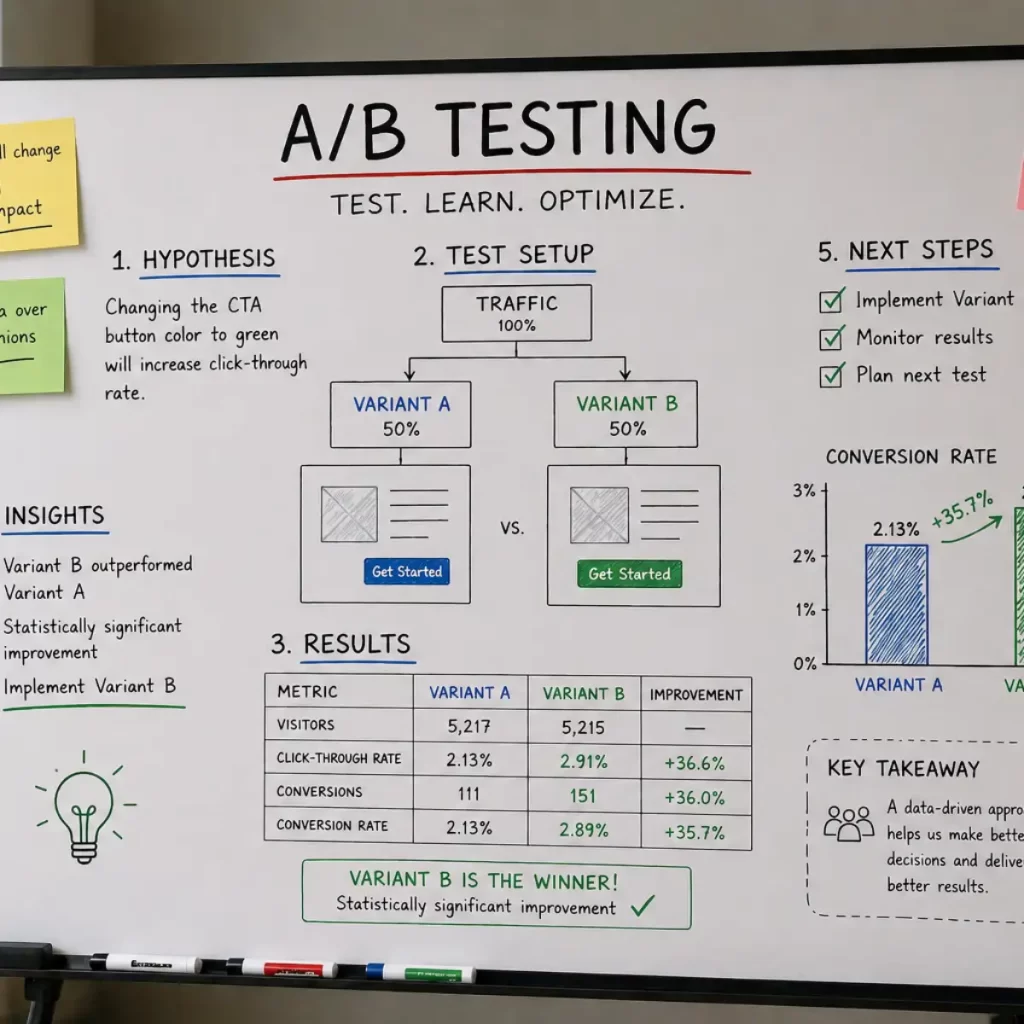
Let’s be serious, in the digital landscape of 2026, if your site isn’t converting, it’s just an expensive digital trinket. And guess what’s the centerpiece that makes the difference between “thanks for visiting” and “take my money”? That call-to-action (CTA) button. Yes, that colored rectangle that many still put on their site “just because,” based on the boss’s taste and what “looks good.” This is where we put “creativity” aside and bring in the heavy artillery: AB testing.
What is AB Testing, in Layman’s Terms?
Imagine you’re a bartender. You have two cocktails: the classic recipe (A) and a new one with a secret ingredient (B). You randomly serve both to 100 customers and see which glass empties faster and gets more orders. That’s split testing, but for your website. You show one half of your audience the original button and the other half a modified version. Then, you measure. Which one brings more clicks, more leads, more money? No more guessing. No more praying to the marketing gods. You have data. Concrete.
Optimizing CTA buttons through AB testing is not a whim, but an absolute necessity to maximize your conversion rate and leave your competition in the dust.
The Anatomy of a Converting Call-to-Action Button: Design, Text, and Placement
A good CTA is like a conversion magnet. A bad one is like a door slammed in the customer’s face. But what makes the difference? No, it’s not a magic formula from some obscure blog from 2012. It all comes down to three puzzle pieces that you can – and must! – juggle in tests to find the winning recipe.
- Design (Color, Shape, Size): Color psychology isn’t voodoo. Red = urgency, “last chance!”. Green = safety, “go for it, it’s okay.” Orange… hmm, Amazon made it famous and it screams “action!”. But what color “pops” better against your site’s background? Test it! Don’t just go by what Pinterest says. Test a plain square versus a friendly rounded circle. Test a “ghost” button (outline only), which is subtle, versus a solid block of color, which is impossible to ignore. Every test is a direct question to your audience. What makes you click?
- Text (Copywriting): Words are bullets. The text on the button is micro-copywriting in its purest form, where every character counts. “Buy” is direct, maybe too aggressive. “I Want Access” puts the power in the user’s hand. “Get Free E-book” sounds like a bargain, while “Download Now” is just an order. That’s micro-copy, folks. This is where money is made or lost. You can test text that highlights the benefit (“Get Silky Hair”) vs. one that indicates the action (“Order Shampoo”). A single word can make the difference between a glorious quarter and a… less glorious one.
- Strategic Placement: Where do you put the “click trap”? High up, ‘above the fold,’ for impatient visitors who scan and don’t read? Or at the end of the page, after you’ve told them the whole story and they’re ready to sign the check? Or maybe a “sticky” button that haunts them like a friendly shadow on the screen as they scroll? Each option has its logic. You can test a single, heroic CTA that dominates the page, versus multiple buttons strategically placed at key decision points. See where the “herd” gathers.
How to Implement AB Testing on Your Buttons Without Getting Your Ears Twisted
Enough with the theory, let’s get our “hands dirty.” AB testing isn’t rocket science, but you don’t do it over coffee either. It’s a process, a recipe. If you skip steps, the “cake” comes out burnt. We, at Danco Vision, have baked thousands of such “cakes” in almost two decades, so we know where the dough can burn and how to avoid a culinary-digital disaster.
- Set a Clear Objective (Hypothesis): Without a hypothesis, you’re fumbling in the dark. What do you want to achieve? More clicks (CTR)? More subscribers? More sales? Be specific. Instead of “I think a blue button would be better,” formulate a solid hypothesis: “Changing the CTA button color from gray (control) to orange (variant) will increase CTR by 15% because orange is our secondary brand color and has higher contrast with the white page background.”
- Create Variants (A vs. B): Start from the hypothesis. Variant A is the control (what you have now). Variant B is the challenge, which contains ONLY ONE MODIFICATION. Write that on a sticky note. If you change the color, text, and shape, and variant B wins, you have no idea why. Was it the text? The color? Congratulations, you learned nothing. Be disciplined. One change per test.
- Set Up the Test in Your Chosen Platform: Log in to your AB testing tool. Set the URL of the page where the battle will take place. Allocate traffic – usually 50/50, like a divorce, so no one gets upset. Then define what “success” means. Is a conversion a click on the button? A visit to the thank you page? A form submission? Make sure you’re measuring what matters.
- Launch the Test and Be Patient (Very Patient): You clicked “Start.” Now, hands off the mouse! Don’t look at the results every 5 minutes. Don’t stop the test after a day just because variant B seems to be leading by a mile. That’s the biggest beginner’s mistake. You need enough data volume to achieve “statistical significance.” Let the test run at least a full business cycle (e.g., 7 days) to cancel out weekend fluctuations.
- Analyze, Implement, and Repeat: Is the test over? Do you have a clear winner, with a statistical significance of over 95%? Great! Permanently implement the winning variant and enjoy the fruits. Was the test inconclusive or did variant B lose? Great again! You learned that your hypothesis was wrong, which is just as valuable. Formulate a new hypothesis and repeat the process. This is the essence of continuous optimization, the pillar of any conversion rate optimization (CRO) guide worth its salt.
Managing this process can be complex, but partnering with an experienced agency simplifies everything. At Danco Vision, we approach every AB test with a clear strategy, ensuring that every decision is backed by data, not assumptions.
Choosing the Right Tools: Life After Google Optimize
Let’s have a moment of silence for Google Optimize. Done. It died in 2023, it’s time to move on. The AB testing tool market is now a Wild West full of options, from expensive “tanks” to agile “pistols.” Besides the industry giants like VWO (Visual Website Optimizer) or Optimizely, you have super cool alternatives like Convert.com, AB Tasty, or even functionalities integrated directly into your platforms.
Are you using HubSpot? You have AB testing. Are you on Shopify Plus? You have it there too. And let’s not forget Google Analytics 4, which, although more convoluted, allows you to do magic if you know how to wield it. The key is to start somewhere. You don’t need a Ferrari to learn how to drive; a tool with a free plan or a trial is perfect for your first button tests.
Analyzing and Interpreting AB Testing Results: From Data to Profitable Decisions
So… you let the test run, you have numbers, graphs, percentages. You’re like a kid on Christmas morning. But what do you do with the “toys”? This is where amateurs are separated from professionals. Understanding the results in depth is what transforms AB testing from a technical exercise into a growth engine.
- The first indicator, obviously, is the conversion rate. But don’t stop there. Look at the statistical significance level. A 95% level means there’s only a 5% chance that your result is pure chance (a fluke). Anything below 90-95% is “meh.” It’s like flipping a coin 3 times, getting “heads” twice and declaring you have a rigged coin. No, you need a solid sample.
- A frequent question is: how long should an AB test run? The correct answer is: “long enough to achieve statistical significance and cover a full business cycle.” This can mean at least a week, ideally even two, to cancel out traffic fluctuations (e.g., different behavior on weekends vs. weekdays). Prematurely stopping a test is the cardinal sin in CRO.
- Go even deeper. Segment the results. Maybe variant B won overall, but lost massively on mobile. Or maybe it worked excellently for Facebook Ads traffic, but failed for organic traffic. These insights are pure gold. They not only optimize a button for you but also give you a deeper understanding of different audience segments. Here, a good data analysis in digital marketing becomes crucial to understand *why* a variant worked, not just *that* it worked.
Common Mistakes in AB Testing (and how not to make them)
The road to CRO (Conversion Rate Optimization) hell is paved with poorly executed AB tests. Seriously, I’ve seen horrors. Here’s a “top of the worst” with mistakes you should avoid like a Monday morning meeting.
- Testing multiple variables simultaneously (Multivariable Mayhem): We’ve said it before, we’ll say it again. Changing both text and color? You’ll never find out which element had an impact. Be disciplined, test one thing at a time.
- Prematurely stopping the test (The “I won!” Syndrome): Enthusiasm can overwhelm you when you see a variant leading by a mile after 24 hours. Resist the temptation! Early data is misleading. Wait for the statistical significance threshold. Patience is a virtue in CRO.
- Ignoring external factors: Did you launch an AB test exactly when you also started a major PR campaign or Black Friday? Your results will be polluted. Try to isolate tests from other marketing events that could massively and atypically influence user behavior.
- Testing trivial changes: Changing one shade of blue (#0000FF) to another very similar (#0000FA) likely won’t bring a dramatic change. Sure, there are exceptions, but at the beginning, focus on high-impact hypotheses (e.g., complete button repositioning, a radical text change, a strongly contrasting color).
- Testing on pages with studio apartment traffic: If you have 50 visitors a day on that page, you’ll be waiting for statistical significance until retirement. Choose battles with impact: homepage, popular product pages, landing pages for campaigns. Where there’s traffic, there’s optimization potential.
Advanced Strategies: Personalizing CTA Buttons and Moving to the Next Level
Have you graduated from AB testing “kindergarten”? Congratulations. It’s time to move to “college”: personalization. The idea is simple: you don’t talk to a stranger the same way you talk to your best friend. Why would you do that on your website? AB testing becomes exponentially more powerful when combined with intelligent audience segmentation.
Here are some examples of strategies that put you in another league:
- Personalization based on traffic source: Show a CTA with the text “Welcome, Facebook reader!” to users coming from the social network and another for those from Google (“I found what you were looking for”). Test if this familiarity increases the conversion rate. Spoiler: it usually does.
- Personalization for new vs. returning visitors: A new visitor, meeting your brand for the first time, might respond better to a low-commitment CTA, like “Learn More.” A returning visitor, who has visited your site 3 times in the last week, is probably ripe for a more direct CTA: “Add to Cart” or “Take Advantage of the Exclusive Offer.”
- Geographic personalization: If you have a chain of pizzerias, a generic “Order Now” CTA is okay. But a CTA that says “Order Hot Pizza in Cluj-Napoca” for a user in Cluj? That’s something else. It’s relevant. It’s personal.
- Multivariate Testing (MVT): Do you want to test 3 headline variants, 2 images, and 3 CTA texts at the same time? This is where MVT comes in. It tests all possible combinations and tells you which individual element (headline X, image Y) has the greatest impact. Beware, however: MVT needs TRAFFIC. A lot of traffic. Don’t run it on grandma’s personal blog.
These benefits brought by advanced AB testing transform a static site into a dynamic and relevant experience. To successfully implement such tests, it is essential to deeply understand audience targeting strategies. Here, the experience of an agency like Danco Vision becomes crucial, as we can correlate demographic and behavioral data to create truly powerful testing hypotheses.
Conclusion:
AB testing is no longer optional. It’s digital hygiene. It’s the engine that transforms your site from a dusty brochure into a sales agent that works 24/7 and gets better every day. It’s about replacing “I think…” with “the data shows that…”. Every test, whether it’s a winner, a loser, or inconclusive, is a brick added to your understanding of your audience. Start small, start today. Formulate a solid hypothesis. Launch a clean test. And build from there a competitive advantage that no one can steal from you: knowledge of your own customers.
If you’re ready to move from assumptions to certainties and turn clicks into loyal customers, our team of CRO experts is ready to build a personalized AB testing program for you. Contact Danco Vision for a consultation and let’s discover the hidden potential of your buttons together.
Articole similare

How Responsive Design influences User Experience on your site
In the digital age, where every click counts and every conversion can make the difference between success and failure, the Performance Max Campaign has quickly

Performance Max Campaign for ecommerce: when and how to use it
In the digital age, where every click counts and every conversion can make the difference between success and failure, the Performance Max Campaign has quickly

Why choose Danco Vision Agency for online promotion?
In a world where an online presence is no longer a luxury but a necessity, choosing the right agency for online promotion can make the



