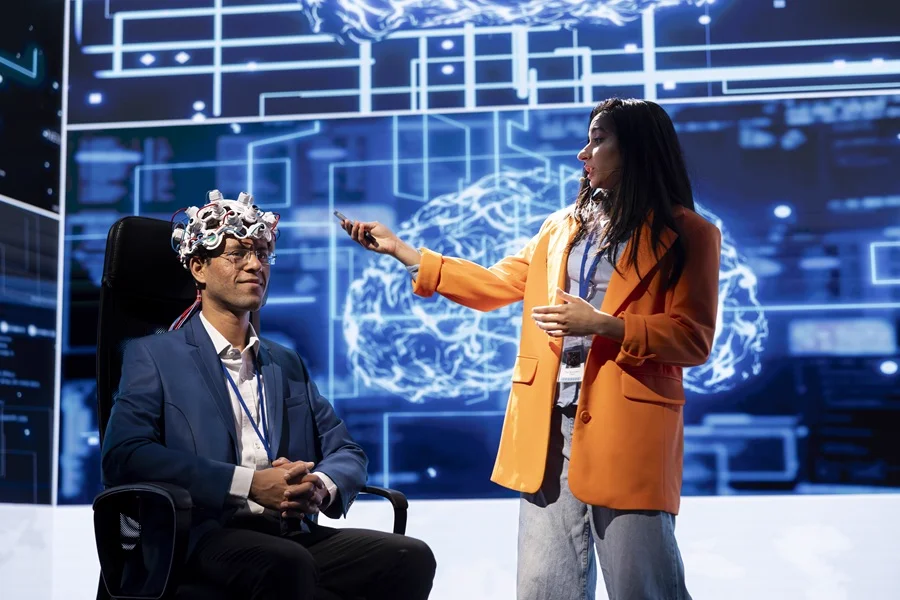
Artificial intelligence is no longer a novelty, but the invisible engine behind every successful campaign. However, the distinction between artificial and human intelligence remains the foundation of any sustainable marketing strategy. AI excels at processing massive data and executing repetitive tasks with inhuman speed, while human intelligence maintains a monopoly over strategic creativity, profound empathy, and ethical discernment.
What is artificial intelligence site and how does it define the present?
A modern definition for artificial intelligence site refers to the implementation of machine learning algorithms and natural language processing (NLP) directly into the architecture and strategy of a digital ecosystem. This allows software to learn from user interactions and execute tasks that traditionally required expert human intervention.
- Natural Language Processing (NLP) for fluid conversational interactions.
- Predictive analysis of consumer behavior for optimizing stocks and budgets.
- Automation of indexing and entity recognition processes for AI search engines.
- Dynamic content generation, adapted in real-time to the visitor's psychographic profile.
Although the concept of AI dates back to 1956, the recent evolution of models like Gemini 2.5 or Claude 4 has radically transformed how a business interacts with its audience. Today, a site that uses artificial intelligence not only displays information but anticipates user needs before they formulate an explicit search.
Direct Comparison: Artificial Intelligence vs. Human Intelligence
To correctly choose where to invest resources, it is vital to understand the strengths of each entity. While AI is unbeatable in volume and speed, humans remain the architects of meaning and cultural context.
As we observe, AI functions as a particle accelerator for data, but without the human filter, the results can be cold, generic, or even erroneous. Currently, success no longer comes from choosing one of the two, but from their perfect integration.
Practical applications of AI in business and marketing
The implementation of AI in business has moved from the experimental phase to operational necessity. From the sales department, where AI prioritizes the most promising leads, to customer support, where virtual assistants offer instant AI solutions, technology optimizes ROI on all fronts. Using SEO & GEO services, companies can now target users not just by keywords, but by their deep semantic intent.
Hyper-personalization and predictive analysis
Personalization no longer means just adding a name to an email subject. We are talking about hyper-personalization, where AI analyzes browsing history, reactions to colors or font types, and even the time of day when the user is most likely to buy. Predictive analysis allows brands to anticipate when a client is about to abandon a service (churn rate) and automatically intervene with a personalized offer.
Google AI Mode and the conversational search revolution
The launch of Google AI Mode transformed traditional search into a continuous dialogue. Users no longer search for 'sports shoes,' but engage in complex conversations: 'I have plantar fasciitis and run on asphalt, what do you recommend under 500 lei?'. In this ecosystem, brands must be present not only through keywords but through factual authority. Content strategies must include intelligent artificial intelligence prompt generation to simulate these dialogues and prepare the most relevant answers.
AI will not replace the marketer, but the marketer who uses AI will certainly replace the one who doesn't. The difference between a leading brand and a mediocre one lies in the ability to infuse automation with authentic human vision. - Daniel Ionescu, Founder Danco Vision
Risks of 100% dependence on artificial intelligence
Although the benefits are immense, ignoring the risks can be fatal for a brand's reputation. One of the biggest dangers currently identified is the so-called 'hallucination' of AI, where the system generates false information with an extremely convincing tone. Moreover, experts have warned that AI can cite compromised sources or websites attacked by hackers that maintain high SEO authority (e.g. government domains transformed into spam pages).
- Lack of transparency: Algorithms can make opaque targeting decisions, difficult to audit.
- Algorithm bias: AI can perpetuate stereotypes present in training data.
- Privacy issues: Massive data collection for hyper-personalization must rigorously comply with GDPR and the new AI Act regulations.
- Erosion of trust: Consumers tend to become skeptical if they feel the interaction is 100% robotic, without an option for human assistance.
To navigate these risks, it is crucial to consult resources on what are the best Generative AI tools currently available? and maintain strict editorial control. Any generated text must pass through the filter of a human editor to check factual accuracy and alignment with the brand's voice.
How to choose correctly: 5 questions to ask before implementation
Before automating a section of your marketing, run it through this set of decision criteria to see if AI is the right solution or if you need human expertise.
- Is the task repetitive and based on large volumes of data? (If yes, choose AI).
- Does the decision involve emotional nuances or empathy for a sensitive customer issue? (If yes, keep the human factor).
- Is the impact of a factual error critical for user safety or finances? (If yes, mandatory human supervision is required).
- Do we need a completely new idea, one that breaks the current patterns of the industry? (If yes, bet on human brainpower).
- Do we want to scale personalized communication to thousands of users simultaneously? (If yes, AI is the only way).
The Evolution of Jobs in SEO and Marketing
Traditional roles have been restructured. The content writer has become a Content Strategist & AI Editor, and the link building specialist has transformed into a Digital PR & Authority Manager. Automation has taken over the 'low-level' work, generating meta-descriptions, basic technical analysis of indexing errors, or identifying post-site migration issues. However, the need for artificial intelligence consulting has exploded, with companies seeking experts who know how to integrate these tools without losing the brand's essence.
For example, someone who knows how to perform efficient artificial intelligence prompt generation can reduce the production time of an editorial calendar from days to hours. It is essential to explore top AI prompt examples in your marketing strategy to remain competitive in the job market.
Next Steps: How to Apply This in 30 Days
If you want to balance AI and human intelligence in your business, start by auditing current processes. Identify where you are losing time with manual tasks that do not bring creative value. Gradually implement AI automation solutions, but always keep a 'human-in-the-loop' for final validation. Do not forget that a new type of ChatGPT subscription is being launched, offering much deeper analytical capabilities for business data, which could be an excellent starting point.
Ultimately, success belongs to those who see AI not as a replacement, but as an extension of human capabilities. At Danco Vision, we help brands navigate this complexity, putting technology at the service of creativity, not the other way around.
Frequently Asked Questions
Key Components and Functionalities of AI Systems
- Machine Learning Algorithms: enable software to learn from experience and improve its performance without explicit programming.
- Natural Language Processing (NLP): the facility to understand, interpret, and generate human language in a contextual and coherent manner.
- Data synthesis capability: processing billions of data points (such as the 300 billion words in LLM databases) for instant responses.
- Tone and context simulation: the ability to replicate affective nuances, humor, or creative styles (poetry, code, prose).
- Predictive analytics: using historical data to anticipate future trends and consumer behaviors.
- Execution automation: taking over repetitive or technical tasks, from writing source code to optimizing advertising campaigns.
The AI Tool Ecosystem and Operational Impact
For the practical implementation of marketing strategies, companies use a mix of accessible solutions and enterprise platforms. While tools like ChatGPT, Claude, and Gemini are used for rapid content generation and conversation personalization, robust platforms like IBM Watson and Tableau AI Analytics allow for complex data analysis and highly precise strategic forecasts.
- Automation of invoice processing and data entry, freeing up human resources for strategic thinking.
- Using TensorFlow for developing customized ML models, adapted to specific business needs.
- AI integration in social media monitoring for real-time analysis of public sentiment towards the brand.
- Intelligent logistics systems that can predict demand and optimize inventory to reduce operational costs.
In sales departments, predictive models not only prioritize opportunities but also suggest the optimal time to contact a potential client, thus maximizing conversion rates through data-driven interventions, not intuition.
Ethical risks and operational limitations of AI in marketing
While efficiency is undeniable, dependence on AI introduces the risk of "biased content." Because algorithms learn from historical datasets, they can perpetuate errors or prejudices if input data is incomplete or inaccurate, which requires rigorous human editorial control to avoid inappropriate messages.
Another critical barrier remains compliance with privacy regulations (GDPR). AI systems require massive volumes of personal data to operate at full capacity, and their improper use can lead to irreparable loss of consumer trust and harsh legal sanctions.
Practical examples of strategic automation
- Automated lead scoring: Instant identification of high-potential conversion customers based on digital behavior.
- Automated variant testing (dynamic A/B testing): Real-time adjustment of messages and visual elements to maximize return on investment (ROI).
- Reducing human errors in scalability campaigns: Precise execution of repetitive tasks in global campaigns, where manual intervention would be inefficient.
AI can generate texts and images based on existing models, but it lacks the capacity to understand the deep cultural and emotional subtleties of the audience, elements that remain the exclusive attribute of human intelligence.
Synergy between automation and human expertise
According to experts at WebFX, maximum efficiency in modern marketing does not come from replacing the workforce, but from integrating AI as a strategic partner. While algorithms handle audience segmentation and technical reporting, human specialists can focus their resources on developing innovative campaigns that require intuition and cultural context.
Specific tasks delegated to artificial intelligence
- Automation of translations and localization: Rapid adaptation of content for global markets, maintaining brand message consistency.
- 24/7 customer support via chatbots: Reducing pressure on human agents by instantly resolving frequently asked questions.
- Identification of consumption patterns: Detecting subtle correlations in large volumes of data that might be missed by manual human analysis.
Ethical and creativity limitations
A critical aspect in the use of AI remains the ethical management of data and respect for privacy. While AI can simulate creativity by recombining existing data, it cannot generate disruptive "out-of-the-box" concepts, nor can it replicate the emotional intelligence needed to authentically respond to consumers' deep needs.
Synthesis vs. Documentation: Differences in user experience
A major distinction between traditional search engines and conversational assistants lies in the user's cognitive effort. While Google provides a vast network of external sources that require manual filtering to form a conclusion, ChatGPT-type models offer a direct synthesis, reducing the processing time for complex information.
- Google: Ideal for validating legitimacy, accessing primary sources, and real-time data (sports scores, breaking news).
- Conversational AI: Excellent for brainstorming, organizing ideas, and explaining abstract concepts in a style adapted to the interlocutor's knowledge level.
- Synergy: Using AI for information structuring, followed by factual verification via Google to eliminate the risk of hallucinations or outdated data.
Efficiency in modern marketing no longer comes from choosing a single platform, but from understanding that these are complementary tools. Google remains the anchor for verifiable information, while AI facilitates rapid access to execution and creative synthesis.
Types of AI-generated content and their visual impact
Beyond simple text, artificial intelligence has revolutionized visual design through its ability to generate high-fidelity graphic elements, such as logos, infographics, and animations, automatically adapted to a brand's color palette and aesthetics. This technology allows for rapid testing of multiple visual variants in digital marketing campaigns, facilitating the identification of formats with the greatest impact on the audience.
Design automation and user experience optimization
- Dynamic visual content generation: Automatic creation of banners and graphic elements that respect the company's visual identity through neural networks.
- Real-time aesthetic analysis: Algorithms that evaluate a site's visual elements and propose adjustments to improve readability and engagement.
- Automated A/B testing: Automatic comparison of content variants to determine which elements (visual or textual) generate higher conversions.
- 24/7 virtual assistance: Advanced chatbots that use NLP to solve complex problems without human intervention, ensuring service continuity.
A critical aspect is AI's ability to analyze consumption data in real time to adjust product or service recommendations as user preferences evolve, a model already established by platforms such as Netflix or Spotify, but now also accessible to medium-sized businesses through 'artificial intelligence website' implementations.
Artificial Intelligence (AI) represents the capacity of a software system to analyze data, learn from experiences, and execute complex tasks that previously simulated human reasoning. In marketing and technology, AI functions as a cognitive accelerator, utilizing advanced algorithms to process information and generate personalized solutions in record time.
Key components of the AI ecosystem
- Machine Learning: Algorithms that allow software to adapt and improve itself based on accumulated data.
- Natural Language Processing (NLP): Technology that facilitates the understanding, interpretation, and generation of human language in a fluent manner.
- Big Data Analysis: The ability to extract patterns and predictions from gigantic volumes of information (over 300 billion words in current models).
- Cognitive Automation: Executing expert tasks (coding, copywriting, financial analysis) with minimal human intervention.
- Recognition and Adaptation Systems: The ability to replicate affective tones, stylistic nuances, and correct errors in complex workflows.
What is AI indexing in search engines and ChatGPT Search?
AI indexing represents the advanced process by which machine learning algorithms analyze and store digital content, emphasizing context, intent, and semantic relevance, rather than simple keywords. This transforms raw data into structured information, allowing platforms like ChatGPT Search to provide personalized and precise answers within modern conversational interactions.
- Contextual analysis: Understanding the deep meaning of phrases for intelligent classification.
- Intent recognition: Identifying the purpose behind user queries.
- Logical structure: Organizing content through concise headings and paragraphs to facilitate reading by AI.
- Experience optimization: Correlating loading speed and information quality with relevance in results.
- Semantic integration: Natural use of keywords to demonstrate source authenticity.
Artificial intelligence represents the capacity of computer systems to simulate human cognitive processes, such as learning, reasoning, and adaptation. By using machine learning algorithms and natural language processing (NLP), AI analyzes massive volumes of data to execute complex tasks, generate creative content, and optimize decision-making processes in real time.
Basic components and functionalities of AI
- Machine Learning algorithms for identifying patterns in data.
- Natural Language Processing (NLP) for replicating human tone, affective nuances, and vocabulary.
- Rapid processing capability for databases exceeding hundreds of billions of words.
- Predictive analysis systems based on the historical evolution of data and trends.
- Conversational interfaces capable of natural interactions, jokes, and literary creation.
- Research automation functions, eliminating the need for traditional manual research.
Artificial intelligence represents the capacity of computer systems to simulate human cognitive processes, such as learning, reasoning, and adaptation. Through advanced machine learning algorithms and natural language processing, AI analyzes massive volumes of data to execute complex tasks, identify patterns, and generate personalized solutions in real time.
- Machine Learning algorithms for adapting to new data.
- Natural Language Processing (NLP) for understanding human context.
- Large-scale data processing capability for identifying trends.
- Decision-making systems based on probabilities and predictive analysis.
- Conversational interfaces capable of replicating tones and affective nuances.
- Software architectures that allow the automation of complex workflows.
The evolution of AI capabilities from simulation to creative execution
Unlike the first systems in the 1950s, which were limited to rigid rules, modern artificial intelligence benefits from over 300 billion parameters in extensive databases. This allows the technology not only to solve mathematical problems but also to generate source code in languages like Python or JavaScript and create creative content, from poetry to graphic design, facilitating a process of digital "humanization" through increasingly natural interactions.
Artificial intelligence represents an advanced software ecosystem capable of simulating human reasoning through machine learning algorithms and natural language processing. In modern marketing, it functions as an execution engine that analyzes massive volumes of data, automates complex workflows, and generates dynamic content, facilitating strategic decisions based on predictability.
- Machine Learning Algorithms: The technical foundation that allows the system to learn from experience and historical data without explicit programming.
- Natural Language Processing (NLP): The component that allows understanding context, tone, and generating human conversational responses.
- Big Data: The vital training resource, comprising billions of parameters and factual information.
- Simultaneous Processing Capability: The ability to execute complex tasks and analyses in real time, surpassing human speed.
- Humanization Models: Style adaptation functions (TOV) to replicate affective nuances and specific user preferences.
Beyond the technical definition, the utility of AI lies in its ability to function as a "digital mentor." It not only stores information but synthesizes it to solve specific business problems, from writing code without logical errors to predicting SEO trends based on the historical evolution of search algorithms.
9 essential aspects about NFTs and their utility in digital marketing
- The technical definition of an NFT: It represents a non-fungible token stored on the blockchain that certifies the uniqueness and originality of a digital asset.
- The difference between fungible and non-fungible assets: Unlike cryptocurrencies like Bitcoin which are interchangeable, each NFT has a unique code that cannot be replicated or replaced.
- Diversity of supported digital formats: An NFT can take the form of any digital file, from images and video clips to audio files or even text.
- The role of Blockchain technology: It functions as a secure digital ledger that stores the complete history of transactions and ownership rights.
- The 'Gas' fee system in trading: Any operation on the blockchain, from creation (minting) to sale, requires paying a fee to miners for data processing.
- Security through crypto wallets: Assets are stored in software wallets (hot) for quick access or hardware wallets (cold) for maximum offline security.
- The distinction between ownership and copyright: Buying an NFT grants ownership of the original, but copyright usually remains with the original creator.
- Integration into the Metaverse: In virtual worlds, NFTs become objects of practical utility, allowing avatar customization through unique digital items.
- Ecological impact and sustainability: Because mining processes consume massive energy, the future of NFTs depends on the transition to green energy and low-emission technologies.
Artificial intelligence represents the capacity of computer systems to simulate human cognitive processes, such as learning, reasoning, and adaptation. By utilizing machine learning algorithms and natural language processing, AI analyzes massive volumes of data to execute complex tasks, identify patterns, and generate creative or technical solutions in real time.
- Machine Learning algorithms for historical data processing.
- Natural Language Processing (NLP) for replicating human tone and nuances.
- Ultra-fast processing capability and accuracy in information rendering.
- Flexibility in generating code (HTML, CSS, Python) and textual content.
- Predictive analysis for anticipating trends and user behavior.
- Systems for automating repetitive workflows (email, SEO, indexing).
The evolution of AI systems: from logic to creativity
Although its foundations were laid in 1956, modern technology has surpassed the limitations of expert systems from the 80s, which could not learn from experience. Today, advanced models like ChatGPT integrate databases of hundreds of billions of words, capable not only of solving logical problems but also of simulating empathy, humor, or artistic creativity through lyrics and design.
Why is website indexing vital in AI-based search engines like ChatGPT Search?
Indexing in ChatGPT Search is essential because the platform is not limited to keywords, but uses machine learning to understand the context and deep intent of the user. Unlike traditional SEO, optimization for AI engines prioritizes conceptual clarity and authority. Correct indexing ensures visibility in complex conversational searches, providing access to a more targeted audience and superior conversion rates through personalized responses, adapted to the specific needs of the consumer.
What is the Metaverse and its role in the digital ecosystem?
The Metaverse represents a vast network of interconnected 3D virtual worlds, functioning as an extension of the current internet (Web 3.0), allowing real-time social and professional interaction through digital avatars. It combines virtual reality (VR) and augmented reality (AR) to create an immersive, persistent, and infinite space where the barriers between digital and physical disappear.
- 3D rendered virtual worlds, permanently active and simultaneously accessible to an unlimited number of users.
- Integration of VR and AR technologies for complete sensory experiences and overlaying digital data over the real world.
- Proprietary digital economy based on blockchain and NFTs for ownership rights of virtual goods.
- Interoperability between platforms, allowing the transfer of identity and digital assets between different ecosystems.
- Co-working and socialization spaces that simulate physical presence, optimizing remote collaboration.
Case studies and data on AI efficiency in marketing
The implementation of AI-based hyper-personalization strategies has generated quantifiable results in various economic sectors. In online retail, the use of predictive analysis led to a 40% increase in conversion rates, while in the financial sector, message automation through micro-targeted segmentation generated a 55% higher ROI.
Data sources for predictive analysis
- Website Analytics: Monitoring user journey and page retention time in real time.
- Social Media Monitoring: Semantic analysis of reactions and comments to adjust campaign tone.
- CRM & Email: Correlating purchase history with current browsing preferences.
- Direct Feedback: Automatic integration of reviews and surveys into the customer's psychographic profile.
An emerging technology with major impact is Computer Vision. This allows AI to analyze the visual preferences of audience segments (for example, attraction to urban landscapes vs. nature) and automatically generate personalized visual content to maximize engagement.
Emerging trends and technological innovations
- Omnichannel Personalization: Integrating messages across all channels (online, offline, mobile) for a unified brand experience.
- Augmented Reality (AR): Creating interactive experiences adapted in real time to the user's profile.
- Voice Marketing: Optimizing interactions through voice commands with personalized AI-generated responses.