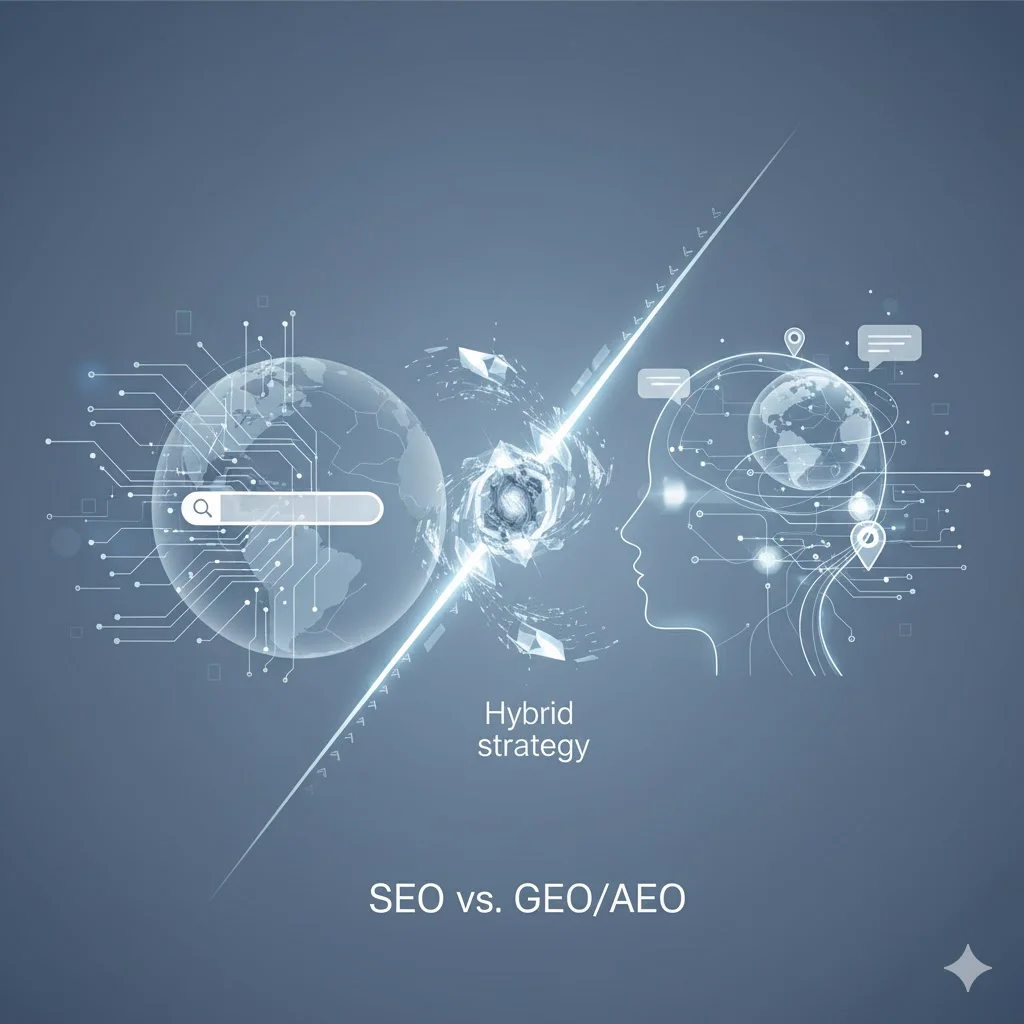
The choice between SEO and GEO/AEO is not an exclusive one, but rather one of prioritization. SEO remains the foundation for authority and volume traffic, while GEO/AEO is essential for capturing users who employ AI assistants. For optimal results, we recommend an integrated strategy that maximizes visibility in both ecosystems.
The digital landscape has been completely reshaped by the rise of generative artificial intelligence. Searches no longer just mean a list of blue links. Now, users receive direct answers, summaries, generated by AI in modules such as Google's AI Overviews. This fundamental shift forces us to rethink online visibility. It's no longer enough to be on the first page; you need to become a trusted source for AI.
The difference between SEO and GEO/AEO: SEO focuses on positioning the site in organic search results lists (SERP), while GEO and AEO aim to optimize content to be extracted and cited by AI-based answer engines. Success depends on the balance between traditional technical structure and informational relevance for LLM models.
What is SEO (Search Engine Optimization) Currently?
Search Engine Optimization (SEO) continues to represent the foundation of any successful online presence. Even in the AI era, the basic principles of SEO remain critical. Think of SEO as the infrastructure and foundation of your digital home: without a solid base, any subsequent construction (such as GEO/AEO) risks collapse.
The main objective of SEO is to improve a site's visibility in the organic results of search engines like Google or Bing. This is achieved through a set of practices divided into three main categories:
- Technical SEO: Ensures that search engines can access, crawl, and index the site's content without problems. Aspects such as loading speed (Core Web Vitals), URL structure, robots.txt file, and sitemap.xml are essential. A poor technical foundation will sabotage both SEO and GEO efforts.
- On-Page SEO: Refers to optimizing elements on individual pages of the site. This includes the natural use of keywords in titles, meta-descriptions, and content, image optimization, text structuring with H2/H3, and creating relevant internal links. This is the level at which content is shaped to be understood by both users and algorithms.
- Off-Page SEO: Consists of actions performed outside the site to increase its authority and reputation. The main pillar here is link building, obtaining quality backlinks from other relevant sites. Authority (signaled by backlinks) is a major factor that AI models use to determine the credibility of a source.
Although effective, traditional SEO faces limitations. The increase in direct answers in SERP (zero-click searches) means that sometimes, even if you are in the first position, the user no longer needs to click on your link. This is where the new disciplines, AEO and GEO, come in.
What are GEO and AEO (Generative / Answer Engine Optimization)?
If SEO focuses on ranking web pages, GEO and AEO focus on transforming content into direct answers. These disciplines do not necessarily aim to bring the user to the site, but to position the brand as an information source directly in the search engine interface or AI assistant.
AEO (Answer Engine Optimization)
AEO is the precursor to GEO. Initially, it referred to optimizing content to appear in the "zero position" , Featured Snippets, People Also Ask, and voice search answers. The goal was to provide a snippet of content so concise and relevant that Google would extract and display it above all other results. These principles are now an integral part of a broader GEO strategy.
GEO (Generative Engine Optimization)
GEO is the natural evolution of AEO in the era of large language models (LLM) such as those powering Google AI Overviews, Perplexity, or ChatGPT. It's no longer just about providing a small snippet, but about structuring your entire expertise in a way that an AI can understand, process, and synthesize. Learn in detail what GEO (Generative Engine Optimization) is and how to apply it in Romania to prepare your site for the future.
Practically, through GEO, you optimize your content to become a cited source in AI-generated responses. This involves:
- Factuality and accuracy: AIs are trained to avoid misinformation. Content must be verifiable, data-driven, and cite credible sources.
- Semantic structure: Intensive use of structured data (Schema.org) to label entities, attributes, and relationships. You tell the search engine, in a language it understands, what a product is, who the author is, what the steps of a process are, etc.
- Clarity and conciseness: Formulating information in direct language, without metaphors or ambiguous phrasing. Short paragraphs, lists, and tables help the AI extract information efficiently.
- Demonstrating expertise (E-E-A-T): Signaling experience, expertise, authority, and trustworthiness is more important than ever. Author pages, citations, and backlinks from respected sources are essential.
SEO vs. GEO/AEO: Direct Comparison
To better understand where to allocate resources, it is useful to directly compare the two approaches. They are not mutually exclusive, but complement each other, having different objectives and measurement methods. The table below summarizes the most important differences.
As can be seen, SEO builds the highway to your website, while GEO/AEO builds the informative billboards and points of interest directly on that highway. A user can get information from the billboard (GEO) or choose to exit the highway to visit the destination (SEO).
When to Prioritize Traditional SEO?
Although GEO/AEO is the new frontier, there are numerous scenarios where classic SEO remains the number one priority. Investing in SEO is rarely a mistake, as its fundamentals indirectly support visibility in AI.
Scenario 1: Online Stores (E-commerce) with Large Catalogs
For an online store with hundreds or thousands of products, SEO is vital. Users search for product categories ("men's running shoes") or specific products ("Nike Pegasus 42"). These searches are transactional, and the intent is to browse and compare options on a website, not to receive an AI summary. SEO for category and product pages, optimization of filters, and internal structure are crucial for capturing this valuable traffic.
Scenario 2: B2B Services with Long Sales Cycles
Companies selling complex services (e.g., enterprise software, financial consulting, engineering services) rely on building long-term trust. Their customers do not make decisions based on a single AI answer. They read case studies, white papers, and detailed blog articles. Here, a content marketing strategy supported by solid SEO is essential to attract the prospect into the sales funnel and gradually educate them.
Scenario 3: Publishing, Media, and High-Volume Blogs
If your business model relies on advertising revenue (affiliation, display ads), traffic volume is king. Your goal is to bring as many eyes as possible to your pages. SEO, especially SEO for news and optimization for Google Discover, remains the main growth engine. Although GEO can bring visibility, it does not directly translate into page views in the same way as classic organic traffic.
Scenario 4: Local Service-Based Businesses
For a plumber in Cluj, a restaurant in Bucharest, or a law firm in Iasi, Local SEO (a sub-discipline of SEO) is non-negotiable. Optimizing the Google Business Profile, getting reviews, and creating location pages are fundamental. Users search for "Italian restaurant near me" and expect a map and a list of options, a format in which traditional Local SEO still excels.
When to Invest Aggressively in GEO/AEO?
GEO/AEO is not just an "add-on." For certain types of businesses, it can be the main strategy for customer acquisition and building authority currently. It is a proactive approach to shaping conversations in your industry.
Scenario 1: Informational Websites and Knowledge Bases
If your website is essentially an encyclopedia in a specific niche (e.g., a website about plant species, a dictionary of medical terms, a car repair guide), GEO is the absolute priority. Your goal is to become the definitive source for facts and data. Structuring information in formats easily parseable by AI (tables, lists, clear definitions) and massive use of Schema Markup will position you as a trusted source for AI Overviews.
Scenario 2: Experts and Thought Leaders
Consultants, analysts, lawyers, doctors, or any professional whose value lies in their unique expertise greatly benefit from GEO. By publishing relevant analyses, answers to complex industry questions, and defining new concepts, you can position yourself as an authority. When a user asks an AI "what is the experts' opinion on X?", the goal is for the AI to cite your analysis.
Scenario 3: Brands Selling Complex, Specification-Based Products
Imagine a manufacturer of PC components, photographic equipment, or specialized tools. Users often search for comparisons: "processor X vs processor Y", "what is the best camera for vlogging?". Creating detailed comparative pages, with clear specification tables and structured data (Schema.org Product), allows the AI to extract this data and use it to formulate an answer, citing you as the source. This is a huge opportunity to influence the purchase decision in early stages.
Scenario 4: Companies in Regulated or Technical Fields
In industries such as pharmaceuticals, finance, or law, accuracy is everything. AIs are extremely cautious about providing information in these areas. A company that can offer extremely precise, factual content explaining legislation, procedures, or technical terms can become a preferred source for LLMs. This is a considerable effort, but the reward is an authority hard to match.
The Hybrid Strategy: How to Integrate SEO and GEO/AEO for Maximum Impact
True power lies not in choosing between SEO and GEO, but in orchestrating them into a unified strategy. A hybrid approach uses the authority built through SEO to lend credibility to content optimized for GEO. Here is a three-step action plan.
Step 1: Build an Impeccable SEO Foundation
You cannot build a GEO strategy on a slow, difficult-to-navigate website with zero authority. Start with the basics. Ensure your site has good Core Web Vitals scores, a logical architecture, is 100% mobile-friendly, and has a clean and relevant backlink profile. AI models use classic SEO authority signals (like conceptual PageRank) to assess trust in a source. Without this foundation, your GEO efforts will be in vain.
Step 2: Create and Adapt Content for Both Ecosystems
Review your existing content and plan new content with a dual perspective. A blog article about "How to choose a laptop" should be SEO optimized for this keyword, but should also contain GEO elements:
- A FAQ section at the end, answering specific questions: "How much RAM is enough for programming?", "Is an OLED screen necessary for photo editing?".
- A comparison table with the specifications of the recommended top models.
- Clear definitions for technical terms like "NVMe SSD" or "refresh rate".
- Concrete data and figures, not just vague opinions. For example: "A 2025 test showed that X series processors offer 15% higher performance in video rendering."
This approach serves both the user who lands on the page through classic search and the AI engine that searches for factual information fragments. Discover more GEO strategies you can use to increase visibility in AI and apply them to your content.
Step 3: Implement an Advanced Technical Layer for AI
This is the glue that binds SEO to GEO. Use structured data (Schema.org) to translate your content into a language machines understand perfectly. Implement `Article` schema with well-defined `author` and `publisher`, `FAQPage` for question sections, `HowTo` for step-by-step guides, and `Product` with `offers` and `review` for product pages. This optimization for artificial intelligence (AIO) is a major technical differentiator, signaling to AIs that your site is a source of structured and trustworthy data. If the process seems complex, turn to experts who can provide integrated SEO & GEO services.
How to Choose the Right Strategy for Your Site? Decision Criteria
The decision to allocate budget and time between SEO and GEO depends on your business context. Use the following criteria to calibrate your strategy:
- Analyze the type of queries in your industry: Use tools like Google Search Console, Ahrefs, or SEMrush to see what your audience is searching for. Are they informational searches like "what is...", "how to..."? Prioritize GEO. Are they transactional searches like "buy...", "price..."? Classic SEO remains king.
- Evaluate current domain authority: Be realistic. If you have a new site with low authority (Domain Authority < 20), competing for high-volume SEO keywords is an arduous battle. A smarter strategy would be to start by dominating answers to very specific (long-tail) questions through GEO, thereby building thematic authority.
- Check competitor presence in AI Overviews: Search for the top 10-20 most important keywords in your industry. Who is cited in AI responses? What kind of content do they have? Do they have tables, lists, structured data? Competitive analysis will give you a clear roadmap of what works.
- Set the main business objective: Do you want traffic volume to monetize through ads? Then SEO is a priority. Do you want ultra-qualified leads and to be perceived as a thought leader? Invest heavily in GEO. Business objectives must dictate the digital strategy, not vice versa.
- Adopt a hybrid model as standard: For most businesses in 2026, the question is not "SEO or GEO?", but "what percentage of resources do we allocate to each?". Start with a solid SEO foundation (30-40% of effort) and build a strong layer of GEO-optimized content on top (60-70% of effort).
The Future of Online Searches: What Awaits Us?
Evolution is far from over. As technology advances, we can expect several major trends that will further accentuate the importance of a hybrid strategy. Personal AI assistants, integrated into operating systems and devices, will become proactive, providing answers based on the user's context, without the user having to explicitly formulate a search. These systems will rely exclusively on structured data and factual information provided through GEO.
Search will become increasingly conversational and multimodal, combining text, voice, and images. The line between a search engine and a conversational assistant will completely blur. In this future, brands that have invested in structuring their knowledge and expertise in a machine-consumable format will have an insurmountable advantage. E-E-A-T principles (Experience, Expertise, Authoritativeness, Trustworthiness) will become the primary filter through which AIs will decide whom to believe and whom to cite. Ask for more details about AEO services offered by Danco Vision!