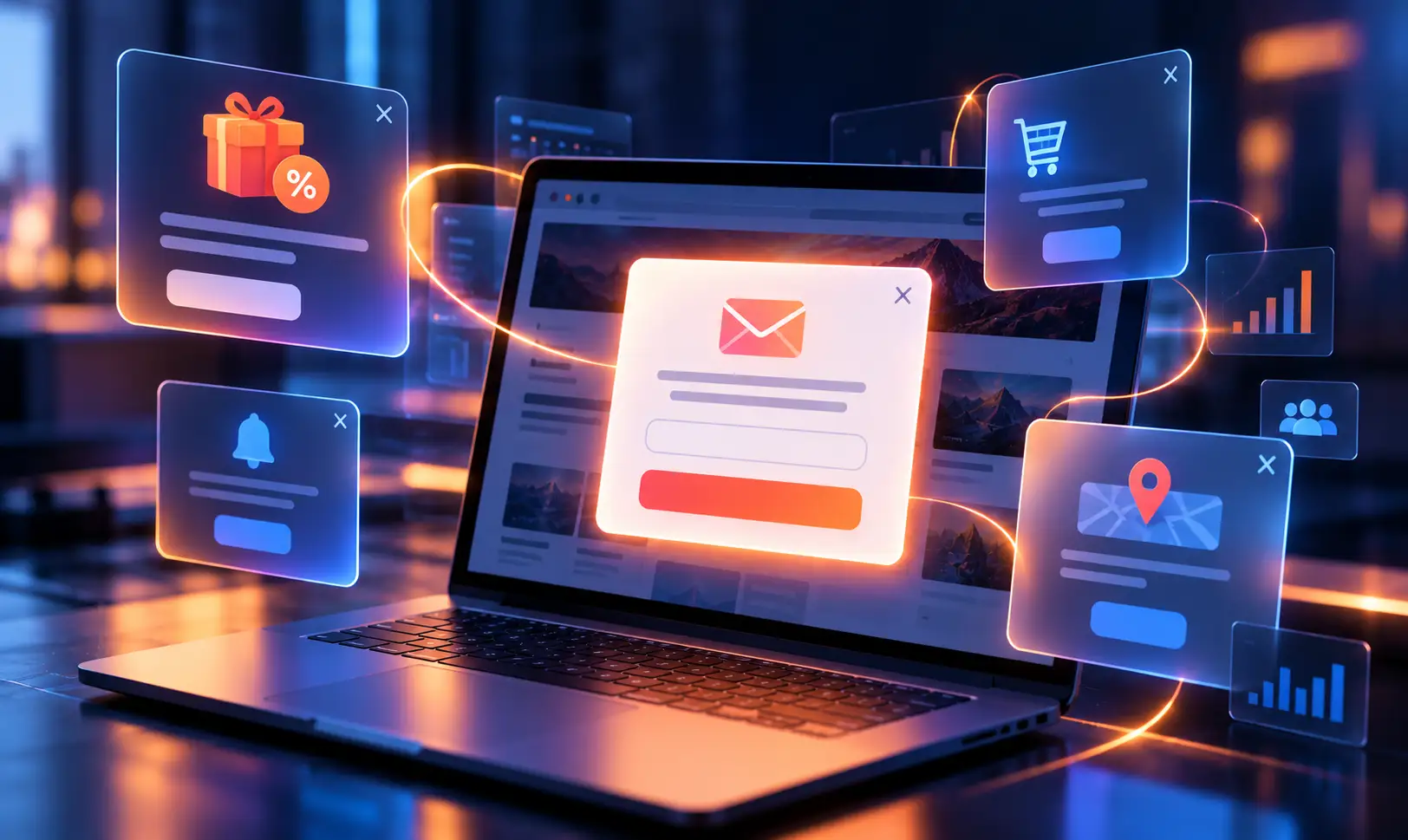
Pop-ups have a pretty bad reputation. For many, they are synonymous with annoying ads from the dawn of the internet, windows that appeared out of nowhere and which you hastened to close. But, in today's digital marketing, equating those relics with a strategic pop-up is like confusing a smartphone with a rotary phone.
Used smartly, pop-ups are surgical tools for increasing conversions, building email lists, and guiding users exactly where you want them.
The difference between a pop-up that annoys and one that converts lies in strategy, relevance, and execution. The right message, delivered to the right person, at the right time, is not an interruption, but a solution. Over the years, here at Danco Vision, we have dissected, tested, and optimized hundreds of pop-up campaigns, transforming them from simple notifications into true conversion engines. This guide is the distillation of our experience - a complete manual for creating pop-ups that not only do not scare away visitors, but turn them into loyal customers.
What are GUI pop-ups and why are they essential?
In simple terms, a pop-up (or pop-up window) is a Graphical User Interface (GUI) window that appears above the main content of a web page, without the user navigating to another page.
Its main purpose is to capture the visitor's immediate attention to communicate a specific message and prompt them to take action. Unlike a simple banner, an internet pop-up is, by its nature, interactive and demands a decision: either you interact with it, or you close it.
In the digital marketing arsenal, pop-ups are essential because they achieve something other elements cannot: to break through the background "noise" and deliver a focused message. They are perfect for specific objectives such as:
- Growing your newsletter subscriber list.
- Promoting a special offer or a limited discount.
- Announcing important news (a new product, an event, etc.).
- Preventing shopping cart abandonment.
- Collecting user feedback.
The key to success is to treat them not as a megaphone, but as a conversation initiated at the opportune moment.
Types of pop-ups and their strategic applications
Not all pop-ups are created equal. Their effectiveness depends on aligning the pop-up type with the campaign objective and the user's context. Each has a specific role in the customer's journey on your website. Let's analyze the main categories of pop-up windows and how you can use them strategically to achieve your goals.
Understanding these mechanisms helps you personalize the experience and dramatically increase conversion chances. You don't want to throw a newsletter subscription offer at a customer who already has products in their cart and is preparing to pay. You might want to offer them a small discount to complete the order. Relevance is king.
Exit-Intent Pop-ups
This is the "secret agent" of pop-ups. Exit-intent technology monitors mouse movements and detects when the user intends to leave the page (by rapidly moving the cursor towards the tab's close button). Precisely at that critical moment, the pop-up activates with a final offer designed to make them change their mind.
It is extremely effective for recovering visitors, reducing abandonment rates, and turning a lost visit into a conversion.
Example of use: "Leaving already? Take a 15% voucher for your first order!"
Time-based or Scroll-based Pop-ups
These pop-ups are conditioned by the visitor's level of interest. A time-based pop-up activates after a user has spent a certain number of seconds on the page (e.g., 30 seconds). A scroll-based pop-up appears after the user has scrolled a certain percentage of the page (e.g., 70%).
Both indicate a level of engagement, making the pop-up offer much more relevant. They are less intrusive than those that appear immediately.
Usage example: After a reader has gone through 75% of a blog article, you can show them a pop-up inviting them to download an in-depth PDF guide on the same topic.
Design and copy: creating pop-ups that convert
Many ask: "Do pop-ups really work?" The answer is a resounding "YES," but it is conditional on the quality of the design and the text. An effective pop-up is a harmonious combination of aesthetics and persuasion. Here are the key elements:
- Strong Headline: It must instantly capture attention and communicate the value of the offer. Be clear, concise, and benefit-oriented. (Ex: "Get 10% Off Now!" vs. "Our Newsletter").
- Clean and Airy Design: Use your brand's colors, but ensure good contrast between text and background. Do not overcrowd the window with text or images. A minimalist, action-centered design is often the most effective.
- Persuasive Text (Copy): Briefly describe the offer, highlighting the direct benefits for the user. Use bullet points to make the information easy to scan.
- Visible Call-to-Action (CTA): The action button must stand out in color and text. Use clear action verbs (Ex: "Download Free Guide", "I Want the Discount", "Subscribe Me").
- Clear Close Option: Do not hide the "X" button. Forcing users to search for how to close the pop-up creates frustration and harms the brand's image.
Advanced targeting and segmentation for maximum impact
The secret to success is not showing the same pop-up to everyone. The magic lies in advanced targeting. You need to deliver personalized messages, based on who the user is and what they do on your site. Correct segmentation can increase the conversion rate from 1-2% to over 10%.
Here are some targeting strategies:
- By traffic source: Display a different welcome message to users coming from Facebook compared to those coming from Google.
- By behavior: Target users who have visited specific product pages with an offer relevant to those products.
- For recurring vs. new visitors: Offer a welcome discount to new visitors and a loyalty bonus to returning ones.
- By device: Ensure the design is optimized. A pop-up on desktop can be more complex, while on mobile (such as in the case of Android pop-up windows or Chrome pop-ups on mobile) it must be extremely simple and easy to close.
Applying these techniques is crucial, whether we are talking about e-commerce development strategies, where you can offer a discount for an abandoned cart, or strategies for corporate websites, where you can offer a relevant case study for the visitor's industry. It all ties into the overall improvement of the user experience through intelligent and personalized web design.
Performance measurement and optimization through A/B testing
Creating a pop-up is just the first step. The true mastery lies in continuous optimization. Do not rely on intuition; rely on data.
Track these key performance indicators (KPIs):
- Impression Rate: How many eligible visitors actually saw the pop-up?
- Conversion Rate: How many of those who saw the pop-up completed the desired action?
- Close Rate: How many users close the pop-up without interacting?
Use A/B testing to systematically test different variants. Change only one element at a time, the title, the image, the CTA button color, the offer, and measure which version performs better. Our experience at Danco Vision shows that small adjustments can lead to significant increases in conversions. The process is cyclical: measure, test, learn, implement, repeat.
GDPR compliance and best practices in Romania
The use of pop-ups, especially for data collection (email, name), falls under the strict incidence of GDPR. Ignoring these rules can lead to hefty fines and loss of customer trust. Many users actively seek pop-up blocking solutions or a popup killer precisely because of abusive practices.
To be compliant and build a trusting relationship:
- Explicit consent: Do not use pre-checked boxes. The user must take an affirmative action (e.g., check a box) to give their consent.
- Clarity and transparency: Explain exactly what you will use the collected data for. Link to the Privacy Policy.
- Easy withdrawal option: Make sure users can unsubscribe as easily as they subscribed.
- Avoid deceptive practices: Do not use texts like "Yes, I want the offer!" and "No, I prefer to pay full price". This is a manipulative practice that generates frustration.
Adhering to these rules not only protects you from legal problems, but also shows respect for the user, which in the long run is much more valuable than a forced conversion.
Implementing an effective pop-up strategy requires technical knowledge, creativity, and a deep understanding of the audience. If you want to convert visitors into customers using advanced and personalized techniques, Danco Vision web design agency is here to help you. Contact us for a consultation and let's build together a strategy that brings real results.