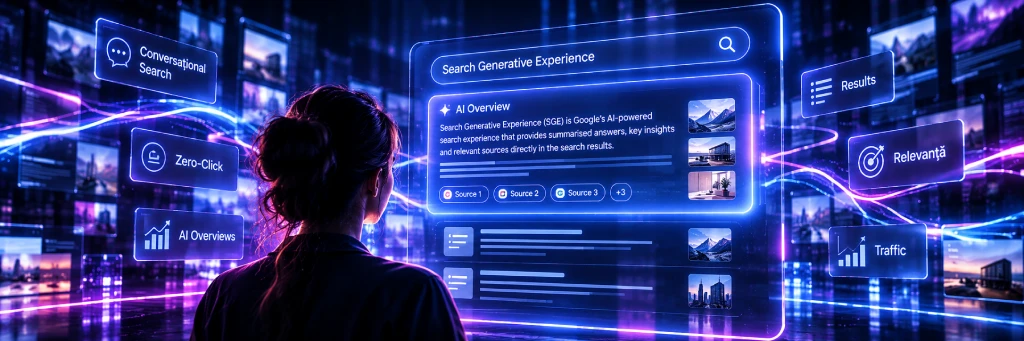
Google is no longer just a search engine that displays a list of links. With the arrival of Search Generative Experience (SGE), artificial intelligence has begun to change the way users receive information and interact with search results. For website owners, this evolution raises an important question: what happens to organic traffic when Google provides the answer directly?
In this context, collaborating with an experienced SEO agency can help companies adapt their visibility strategies.
What is Search Generative Experience and how does it work?
Search Generative Experience was the name of the experimental experience through which Google introduced AI-generated answers into its search engine. The technology subsequently evolved toward features such as AI Overviews, which synthesize information from multiple sources and present it directly on the results page.
The main features of this experience are:
- AI-generated answers: information is synthesized into a summary tailored to the user's query.
- Relevant sources and links: answers may include links to websites to explore the information in greater depth.
- Conversational searches: users can formulate complex questions in natural language.
- Follow-up questions: conversational experiences allow users to continue the search through additional questions.
- Integration of multiple types of information: depending on the query, answers can combine explanations, recommendations, and other elements from the Google ecosystem.
These features do not appear for every search, and the display format differs depending on the topic, device, and the availability of Google products.
How does SGE influence organic traffic?
The impact is not uniform. Some websites may lose clicks for informational queries, while others may gain visibility by being included in the sources featured by AI.
1. The Rise of Zero-Click Searches
When users receive the desired information directly in the SERP (Search Engine Results Page), they no longer always need to visit a website.
The Zero-Click phenomenon particularly affects simple informational searches: definitions, brief explanations, frequently asked questions, or basic instructions.
Websites that predominantly publish this type of information, including encyclopedias and aggregators, may lose some of the visits previously generated by these queries.
2. Classic organic results are pushed further down
Traditional results, known as Blue Links, can appear below the AI Overviews blocks.
On mobile devices, the space taken up by the generated summary can lead users to scroll more to reach the first classic organic result.
This shift can reduce the CTR (Click-Through Rate) even for pages that maintain their rankings in Google. Therefore, a good ranking no longer guarantees the same visibility or the same volume of clicks.
3. Searches become more conversational and specific
Users can formulate longer questions, with details about their needs and preferences.
For example, instead of "running shoes", a search can become "asphalt running shoes, with pronation support, under 500 lei".
These Long-Tail queries and follow-up questions create opportunities for websites that provide specialized answers, in-depth explanations, and relevant information for specific situations.
4. Fewer visits, but potentially more qualified
A user who visits a website after checking an AI summary may already have the necessary general information and may be looking for additional details before making a decision.
This behavior can bring traffic with clearer commercial intent and, in certain situations, better conversion rates.
However, it should not be assumed that traffic coming from AI experiences automatically converts better. Results depend on the industry, the type of search, and the stage the user is in.
How do you adapt your SEO strategy to AI-generated searches?
The first step is to stop evaluating performance solely through rankings and total visits. Traffic quality, conversions, brand visibility, and presence in AI-generated answers also matter.
To support this visibility, you can integrate AEO services into your existing strategy, focusing on clear answers, well-organized content, and easily identifiable information.
A few important directions:
- Original content and real experience: case studies, proprietary research, practical examples, and information backed by expertise.
- E-E-A-T: highlighting experience, expertise, authoritativeness, and trustworthiness through identified authors, verifiable sources, and updated information.
- Semantic structure: relevant headings, concise explanations, useful FAQ sections, and Schema.org structured data where applicable.
- Technical optimization: pages accessible for crawling, proper indexing, and important content available to Google.
- Covering complex intent: answers for specific questions, comparisons, and use cases.
It is important to note that structured data and content formatting do not guarantee citation in AI Overviews. They contribute to the clarity and interpretation of information, but source selection depends on Google's systems.
From SEO to GEO: visibility is no longer measured only in clicks
The shift brought by AI expands the goals of organic optimization. In addition to attracting visitors, brands aim to be present in the answers provided by search engines and AI assistants.
To understand what GEO is, this discipline should be viewed as a complement to SEO: optimizing information to increase the chances of a brand being identified, understood, and mentioned in automatically generated answers.
SEO remains the technical and editorial foundation, and GEO expands the perspective on visibility in AI ecosystems.
What is next for organic traffic?
Search Generative Experience marked the beginning of an important shift, continued through AI Overviews and other search experiences based on artificial intelligence. Simple informational traffic may become harder to obtain, while specialized, original content relevant to complex decisions may gain importance.
At Danco Vision, we approach SEO and GEO as parts of the same organic visibility strategy, tailored both to traditional searches and to Generative AI-based experiences. The goal is not just attracting clicks, but building a relevant digital presence wherever users look for answers.