To say that you need a website for your business today is like saying you need air to breathe. It's obvious. The real challenge, however, as experts in the field emphasize, is not just having a site, but being able to manage it efficiently, turn it into a growth engine, and not be at the mercy of the programmer for every comma you want to change. This is where the hero we set out to talk about comes into play: Content Management System or, in short, CMS.
What is a Content Management System (CMS)?
Let's start from scratch. Imagine your website is a glossy magazine. The content (articles, photos, titles) is the raw material, and the design (layout, fonts, colors) is the page arrangement. In the past, to change a photo or correct a mistake in a text, you practically had to redesign the entire page. It was a rigid, costly, and slow process.
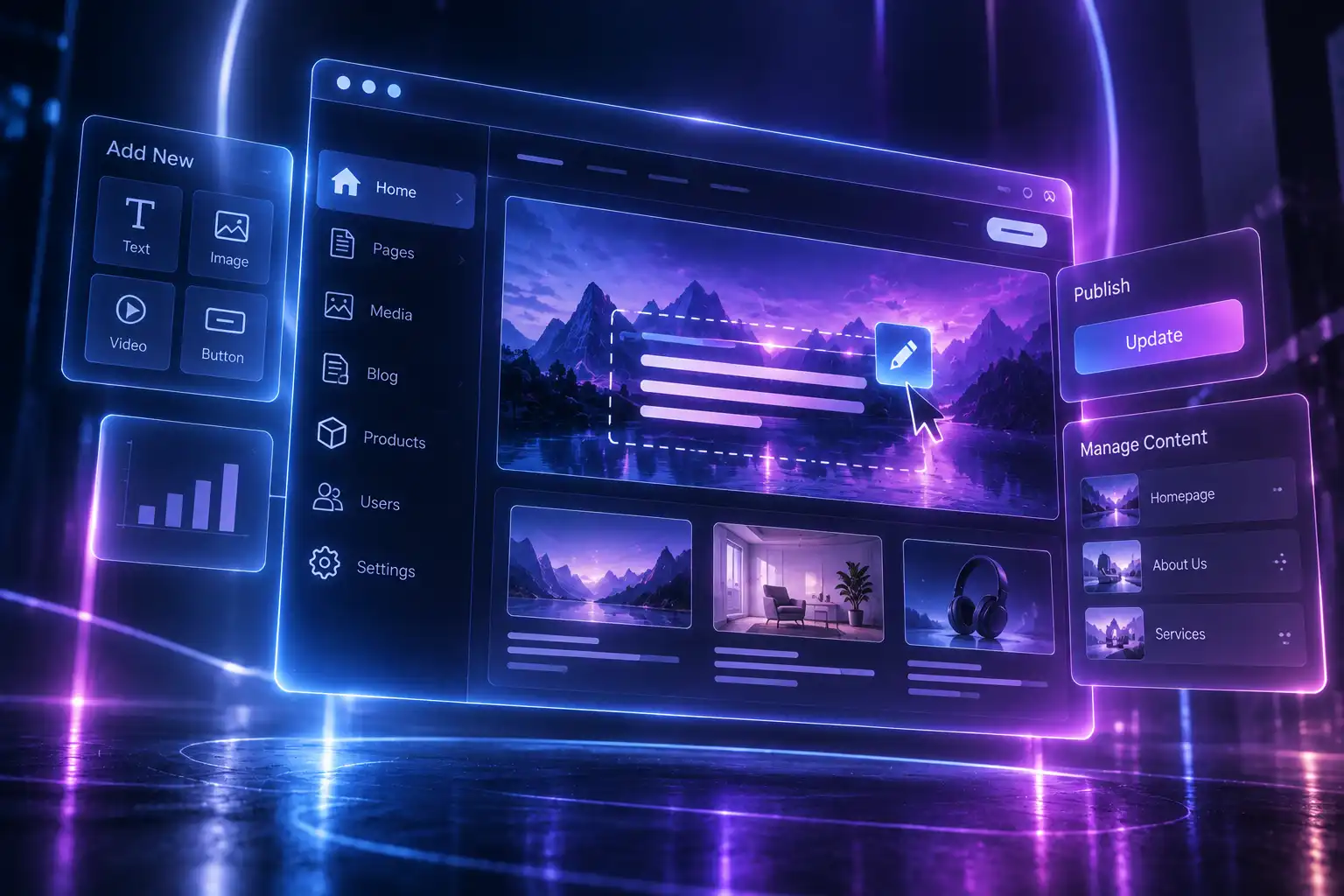
A Content Management System (CMS) has completely revolutionized this process. It is a software application that separates content from design. Specifically, a CMS system offers you a "control panel" (back-end), where you can add, edit, and organize all your content in a database. Then, the system takes this content and displays it to visitors on the "visible part" of the site (front-end), using a design template (theme or template).
Essentially, a web CMS acts as an intelligent intermediary. You focus on what you want to say (the content), and the CMS takes care of how it looks (the presentation). This means you can publish a new blog post, add a product to your online store, or update your working hours without needing knowledge of HTML, CSS, or JavaScript. It grants autonomy to the marketing team, streamlines workflows, and, most importantly, democratizes online presence management.
Advantages of using a CMS for Romanian businesses
Adopting a CMS is not just a technological whim, but a strategic business decision with a direct impact on agility and profitability, especially in a dynamic market like Romania. The benefits are multiple and tangible, transforming the website from a simple digital brochure into a valuable asset that works for you 24/7.
Here are the main CMS benefits that matter:
- Autonomy and total control: The biggest of all content management system advantages. You no longer depend on an agency or a freelancer for minor modifications. Do you want to announce a flash promotion at 10:00 PM? You can do it yourself, in a few minutes. This agility allows you to react quickly to market opportunities and keep content fresh and relevant, an essential factor in the eyes of Google and your customers.
- Cost efficiency: Although the initial investment in a site on a CMS customized by an agency may seem higher than a "turnkey" solution on a closed platform, long-term costs are significantly lower. You dramatically reduce maintenance costs for content changes and can allocate the budget to areas that truly add value, such as creating quality content or marketing campaigns.
- Scalability and flexibility: A business grows, and the website must keep up. A robust CMS allows you to add new functionalities over time: a blog, a forum, an e-commerce module, a booking system, etc. Whether you use plugins, extensions, or custom modules, the platform evolves with your vision.
- SEO Friendly by Design: Most modern CMS platforms are built with best SEO practices in mind. These CMS advantages include friendly URLs, the ability to edit meta titles and descriptions for each page, automatic sitemap generation, image optimization, and a clean code structure that search engines can understand and index efficiently.
- Simplified collaboration: A CMS allows the creation of multiple accounts with different access levels. Thus, the copywriter can write articles, the marketing specialist can create landing pages, and the manager can approve the content before publication, all in a centralized and secure environment.
Integrating the CMS with digital marketing strategies
A high-performing CMS is not just a content repository, but the epicenter of your entire digital marketing effort. It is the foundation upon which successful campaigns are built and executed.
At Danco Vision, we see the CMS as a strategic hub that connects all communication and sales channels. Correct integration between CMS and SEO, content marketing, and performance marketing is the key to unlocking the true potential of your online presence.
Think of CMS as the conductor of an orchestra. Each instrument (SEO, Social Media, Email Marketing, PPC) must play in harmony to create a successful melody. For example, you can publish a blog article (Content Marketing), optimize it for search engines directly from the CMS (SEO), create a dedicated landing page to promote a guide related to the article (Performance Marketing), and then distribute everything on social media with links to the website. All these actions are managed and facilitated by the CMS. Moreover, by integrating with analysis tools (Google Analytics, Hotjar), you can measure the performance of each page and continuously optimize your strategy.
An experienced agency, offering complete web development services, will ensure that these integrations are implemented correctly from the start, for a coherent data flow and measurable results.
Types of CMS platforms and choosing the right one
The CMS universe is vast and diversified, and choosing the right platform for your business is a crucial decision. There is no universal "best" solution, only the "most suitable" for your specific needs, budget, and objectives. Broadly, platforms fall into a few main categories.
- Open-Source CMS: These are platforms whose source code is public and can be modified by anyone. They are extremely flexible and supported by huge global communities.
- WordPress: The undisputed king, powering over 40% of websites on the internet. A WordPress CMS is incredibly versatile, easy to use, and has a gigantic ecosystem of themes and plugins. Ideal for blogs, presentation websites, and even small to medium-sized online stores (with WooCommerce).
- Joomla: A powerful option, somewhere between the simplicity of WordPress and the complexity of Drupal. It is excellent for social networking sites or complex portals, but has a slightly steeper learning curve.
- Drupal: Considered the most secure and robust, Drupal CMS is the preferred choice for government projects, universities, and large corporations. It offers unparalleled flexibility and scalability, but requires advanced technical knowledge for implementation and maintenance.
- SaaS CMS (Software as a Service): These are subscription-based platforms where you pay a monthly fee to use the software, hosting, and support. They are less flexible, but extremely easy to use (e.g., Wix, Squarespace, Shopify for e-commerce).
The CMS selection process must start with an internal analysis: What do you want your website to do now and in 3 years? What level of technical knowledge does your team have? What is the available budget? Consulting with experts can save you a lot of headaches in the long run.
Essential Features to Look for in a CMS
Regardless of the type of CMS you choose, there are some critical functionalities that should not be missing. These CMS features ensure a pleasant user experience, long-term performance, and the security of your data.
- Intuitive content editor: Look for a WYSIWYG (What You See Is What You Get) interface that allows you to format text and add media as simply as in a text editor.
- Flexibility and customization: Make sure the platform allows design customization (through themes) and functionality extension (through plugins or modules).
- User role management: Essential for teams, it allows you to grant different permissions (administrator, editor, author) to each member.
- Built-in SEO capabilities: The ability to edit URLs, titles, meta descriptions, and alt attributes for images is non-negotiable.
- Robust security: A vital aspect. Check the frequency of security updates and the existence of options for backups and protection. Good CMS security is the foundation of online trust.
- Support and community: An active community or dedicated technical support means you will find quick help when you encounter problems.
The Role of Danco Vision Agency in CMS Implementation and Optimization
Choosing a CMS is just the first step. True value is unlocked through correct implementation, customization according to business needs, and continuous optimization. With over two decades of experience in the Romanian market, started in 2006, Danco Vision Agency offers not just services, but strategic partnerships to transform your CMS into the most powerful marketing tool.
Our integrated approach covers the entire lifecycle of a web project:
- Consultancy and Strategy:
Before writing a single line of code, we analyze your business objectives, target audience, and competitive landscape to recommend the most suitable Danco Vision Agency CMS platform. We do not believe in universal solutions, but in personalized architectures.
- Implementation and Custom Development:
Our team of developers delivers impeccable CMS implementation. We build custom themes from scratch and develop specific functionalities, whether we are talking about complex corporate websites that need to reflect the brand's scope, or successful landing pages, optimized to the core for conversion.
- CMS Optimization and Performance:
A site must be not only beautiful, but also fast and visible. We handle CMS optimization at a technical level (loading speed, clean code), on-page SEO optimization, and the configuration of all necessary integrations for monitoring and analysis.
- Continuous Support and Maintenance:
The digital world is constantly changing. We offer CMS support and maintenance packages to ensure your website is always updated, secure, and functioning optimally, allowing you to focus on growing your business.
The Future of Content Management Systems
The content management landscape is evolving at an astonishing speed, and the present finds us at a fascinating inflection point. New CMS trends are moving away from traditional monolithic systems and towards more flexible, intelligent, and user-experience-centric architectures.
One of the most important concepts is the headless CMS. In a headless system, the back-end (where you manage content) is completely decoupled from the front-end (the presentation layer). This means that the same content can be delivered via APIs to a multitude of platforms: a website, a mobile application, a smartwatch, a digital display, or even a voice assistant. Flexibility is maximized.
Another major trend is the deep integration of Artificial Intelligence. AI is no longer a dream, but a reality. It is used to generate content suggestions, to optimize SEO in real-time, to personalize the experience for each individual visitor, and to automate repetitive tasks such as image tagging. The future of CMS is one where the platform becomes a proactive partner, not just a reactive tool.
Choosing, implementing, and managing a Content Management System might seem daunting tasks, but they are essential for anyone who wants to succeed in the digital environment. A CMS is more than just software; it is the foundation upon which you build your visibility, credibility, and relationship with clients.
If you are ready to take control of your online presence and turn your website into a real growth engine, the Danco Vision team is here to guide you. Contact us for a personalized consultation and let's build the digital future of your business together.