Imagine you have a super-radar for your ideal customer. You know exactly when they walk past your store and, BAM!, you send an irresistible offer right to their phone. No, it is not sci-fi, it is geofencing, the secret weapon in the marketing arsenal that many still ignore. If you are tired of 'spray and pray' marketing and want surgically precise campaigns that actually bring in money, you have come to the right place. Let's analyze this new toy and see how it can make your conversions explode.
What is geofencing and how does it work in digital marketing?
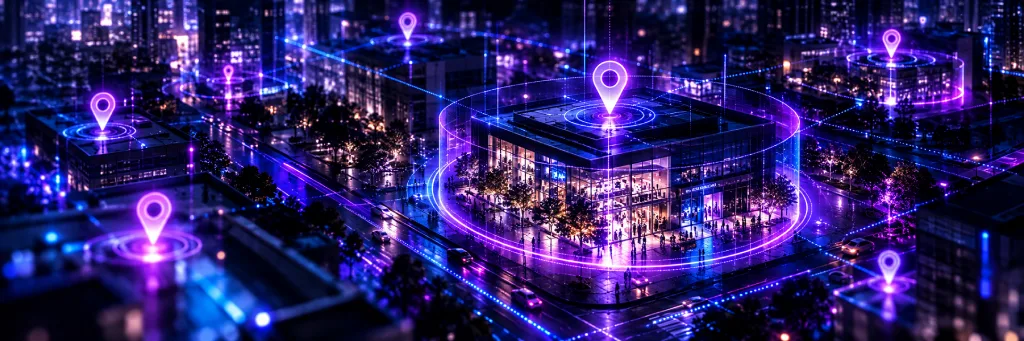
In short, geofencing (or "geo-fence", if you want it to sound like a fortress) is a technology that draws a virtual fence around a real-world location. Think of it as an invisible lasso you cast on the map around your store, a competitor, or a festival. When a user with your app (or a partner's) enters or leaves this area, pop!, a trigger goes off: a push notification, an SMS, an email, or a personalized ad on social media.
Behind the scenes, the engine uses GPS, Wi-Fi, cellular data, or beacons to know where the person's phone is. That is how you get ultra-targeted campaigns that are as relevant as it gets.
The strategic role of geofencing in driving conversions
The trick with geofencing lies in its power to deliver the perfect message to the right person, at the... you guessed it, perfect place and time. In plain English, that means a massive boost in conversions. Why? Because you are no longer bombarding someone with generic ads while they are relaxing on TikTok.
Instead, you offer value right when purchase intent is at its peak, when their card is practically jumping out of their wallet. Concrete example: a customer walks into a mall and instantly gets a notification: "Hey, today you get 20% off with us on the 1st floor." A well-crafted geofencing strategy makes an unbeatable team with your Local SEO efforts. SEO lifts you up in "near me" searches, and geofencing takes the baton and turns that click into a real, in-store customer.
Practical applications and case studies
The possibilities are endless and work across any industry, from retail to real estate. In Romania, brands that do not sleep at the wheel are already using geofencing with amazing results.
- Retail: A fashion store can "hook" loyal customers with vouchers as they approach. Even smarter: it can "steal" customers right from the competition with an irresistible counter-offer.
- Restaurants and Cafes: A clever cafe sends lunch menu notifications to corporate workers in neighboring buildings right at 11:30 AM. Simple and devilishly effective.
- Events: At a festival, you can send the schedule, maps, or bar offers directly to attendees' phones. No more lost flyers.
- Real Estate: A potential buyer walks into a target neighborhood? BING! They instantly get a list of available apartments in the area.
At Danco Vision, we have implemented campaigns where a simple geo-targeted notification increased in-store foot traffic by over 30% in the first weekend. We talk about results, not stories.
Integrating geofencing with other digital marketing channels
Geofencing is not a one-man show. Its real power explodes when you integrate it into a complete digital marketing strategy. Combine location data with what you already know from your CRM, and you will create campaigns with an almost telepathic level of personalization.
Imagine this: a customer abandons an online cart with some shoes. A few days later, they walk past your physical store and receive a notification: "Those cool shoes are waiting for you 200m away. Come try them on!". You can also use the data to create retargeting audiences on social media or to segment email lists.
A 360° approach, developed by an experienced digital marketing agency, ensures that every customer touchpoint is finely tuned for conversion.
Advanced analytics and measuring ROI in geofencing campaigns
And now, the million-dollar question: how do you know it works? Simple: you measure everything. Here we do not rely on 'gut feeling', but on concrete data. Core KPIs, such as walk-through rate (how many saw the ad and then entered the store) and conversion lift (how much conversions increased compared to a control group), are non-negotiable.
They show you the direct impact on foot traffic. Then, by connecting everything to the POS system or e-commerce platform, you can calculate an exact ROI (Return on Investment). By analyzing the numbers, you continuously optimize virtual fence radiuses, the times you send notifications, and the copy, so you squeeze every single penny out of your campaign.
Ethical considerations and GDPR compliance
Alright, let's also talk about the serious part. As a wise guy once said, with great power comes great responsibility. Using location data is a sensitive topic, and respecting privacy is the law, not a negotiation.
In the EU, any geofencing strategy must be 100% compliant with GDPR. In short, this means total transparency. Users must give explicit, informed consent (opt-in), not tricked with a checkbox hidden in 30 pages of T&Cs. And, just as importantly, you must give them a simple way to say "STOP" (opt-out).
An ethical approach not only saves you from hefty fines, but it also builds trust. And trust, in the long run, is worth more than any campaign.
The future of geofencing in digital marketing
If this seemed cool so far, hold on tight, because the future is even more spectacular. AI has started dynamically optimizing virtual fences and real-time messaging based on weather, traffic, or local events.
Integration with Augmented Reality (AR) will create location-triggered immersive experiences, think of pointing your phone at a restaurant and seeing reviews floating near the entrance. Personalization will reach a truly sci-fi level, moving from segments to 1-to-1 hyper-personalization. We will have a non-stop contextual dialogue between brand and consumer. The future means maximum relevance, and geofencing is the engine behind it.
Sounds complicated? Maybe a bit, but it is not rocket science, especially when you have the right partner. A rock-solid geofencing strategy requires a mix of technical skills, creativity, and a fine understanding of consumer psychology.
The team at Danco Vision, with 20 years of experience in the digital jungle, has the know-how and tools needed to build geofencing campaigns that deliver results, not excuses. From strategy to implementation and analysis, we help you turn proximity into profit.